Introduction to WWII and Inquiry Project
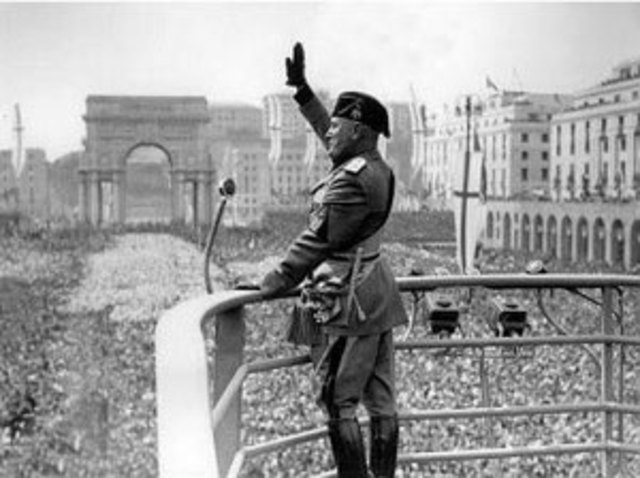
(Above) Mussolini greets a giant crowd.
Towards the end of the 20's and 30's Mussolini, Hitler, Stalin, and others used the instability of the times build their totalitarian states. In the time of the Great Depression, these states effectively organized working parties to build up the country at the expense of unfortunate groups of individual.
It was a time of power consolidation and tyranny.
It was a time of power consolidation and tyranny.
Key Vocabulary
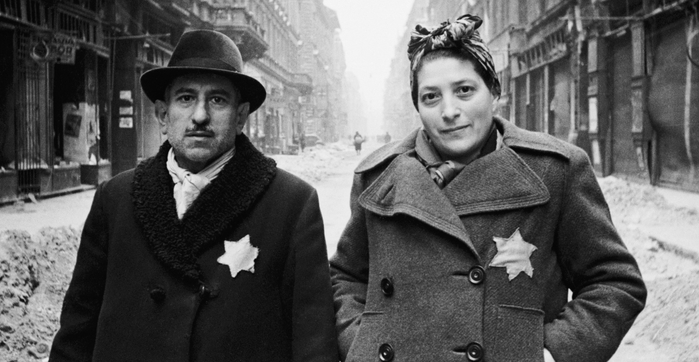
The Master Race
During the time of Hitler's ascension to power, the Nazi Party believed that the German people were a "master race" of Aryans. They persecuted any ethnic or minority group outside of this image. Jewish people were a focus of this hateful ideology, but weren't the only group persecuted. Other groups of differing beliefs and ethnic backgrounds were persecuted and exploited.
These were some of the ideas that the Allies fought to prevent from spreading during the war.
Anti-Semitism
Discrimination and hostility towards Jewish people.
Even countries such as Canada had become increasingly anti-semitic by the late 1930's.
Thankfully the situation has improved much since that time in history.
Artifact
An object made by human beings , especially with a view to subsequent use. (Source)
Things that we look back in time and feel are representative of that time.
Essential Questions

- Stalin's Soviet Union
- Mussolini's Italy
- Hitler's Fascist Germany
- Imperialist Japan
- Fascism in Spain
- Hitler's Imperialistic Ambitions - Hitler wanted to take over the world.
- The world trying to appease Hitler's ambitions by allowing him to take over and become more and more powerful.
- The Nazi-Soviet Non-aggression Pact made it easier for both countries to maneuver.
- League of Nations Failure - Other conflicts couldn't be stopped. Lack of confidence in the League. (Japan in Manchuria and Italy in Abyssinia )
- Canada had a policy of Isolationism towards the issues of anti-semitism and Hitler's increasing power.
- The thought was that Canada had already sacrificed much and couldn't give charity.
- Mackenzie King made a diplomatic mission to Germany
- Canada rejected the SS St. Louis.
- Rather than automatically joining like in WWI, Canada put the question to Parliament and made the final decision on September 1, 1939 to join WWII.
- By looking at objects from the past, we can discover more about the history of an object and how they were used. They are useful windows into the past.
- At sea, Canada was important for keeping the lifeline open to Britain. They guided convoys of merchant vessels as they made their way to Britain and back.
- In the air, Canada had many training bases and contributed much to the war effort. Many Canadian pilots also contributed to the controversial bombing raids over Germany.
- On land, Canada contributed to the main campaigns, but notably took the lead in an unfortunate landing in Dieppe. On this disastrous day, many Canadians lost their lives on an attempt to get a toe-hold back in Europe. While this was a disaster, much was learned that would be later used in D-Day and it is believed that this raid also was necessary in order to keep Russia into the war.

Project and Homework
You have been assigned an assignment where you look up the history of WWII through an object from the war. By looking at an object, we can learn a lot about the history and the time which it was made in.
Starting off with physical characteristics and then developing questions about the times and circumstances, research will be done and then the result can be presented to the class Via Gallery Walk.
Comments
Post a Comment